Welcome to FirstAid4Free

Welcome to my first aid site. I'm a first aid trainer and assessor. I've been teaching first aid for about 10 years now. Everyone should have some first aid knowledge for in the home and work place. Not everyone has the chance to attend a full first aid course so I'll provide some key first aid points every week.

Important Notice

The information on this site is for guidance only. The first aid procedures are those in the current edition of the First Aid Manual at the time of inclusion on the site. Attendance on a first aid course to practice these procedures is always recommended.

Quick Review: Feller Medical

Baldness is a terrible affliction - sometimes
a wig just doesn't do the job!


This post is sponsored by Feller Medical. To view my policy on sponsored entries click HERE.

People often say that as you get older, you also get wiser. It's also true that as you get older you start to get forgetful, saggier and your hair falls out. If you are particularly concerned about your thinning thatch you might consider a hair transplant. New York based Feller Medical offer practical and permanent hair loss solutions. Dr. Feller personally examines each patient and discusses their requirements before treatment begins. Hair restoration techniques include traditional strip hair transplants and the newer, scalpel-free fue hair transplant technique. If you would like to learn more visit the Feller Medical website.

Welcome to FirstAid4Free

A tiny piece of housekeeping I have so far neglected - the firstaid4free small print:

About this Blog:
FirstAid4Free is a free guidance source for use in the home and work place. It gives details of the first aid procedures recommended by the Voluntary Aid Societies of the United Kingdom at the time of inclusion on this site. First aid procedures are continually being updated and refined - I will endeavour to keep FirstAid4Free updated too, but I recommend you consult the current edition of the First Aid Manual to get the latest 'accepted practice'.

Firstaid4Free is not a substitute for proper hands-on first aid training by an experienced trainer. I always recommend that you attend an HSE accredited first aid course if you have the opportunity.

Sponsored Entries:
Please note that FirstAid4Free may occasionally include sponsored entries. I will endeavour to write all sponsored entries in a tone which reflects my true opinion of the subject - advertisers please be aware of this before you submit your proposal. Sponsored entries will always include the words 'advertisement' or 'sponsored post'. I hope that these posts do not detract from your enjoyment of my other posts.

Copyright Notice:
If you find any of the information on this site useful you are free to reproduce and republish it elsewhere on condition that you acknowledge and provide a back link to FirstAid4Free.

Severe Allergic Reactions (Anaphylaxis)

Using the EpiPen.

Anaphylaxis is a severe allergic reaction with symptoms that develop within minutes of being triggered. It causes swelling of the airways resulting in impaired breathing, collapse and is potentially fatal. A casualty experiencing anaphylaxis needs urgent medical attention immediately - don't delay calling an ambulance.

Quite often the casualty knows that they suffer from anaphylaxis and they make adjustments to their life to avoid the triggering factor. Those with severe allergies also carry medication as a precaution. Some of the more common triggers include peanuts, fish, rubber, dust and insect stings. Be aware that a person can suddenly develop a severe reaction to a product they have had trouble-free exposure to in the past.

Recognition:
  • Impaired breathing.
  • Wheezing and gasping for air.
  • Signs of shock.
  • Widespread blotchiness of the skin.
  • Swelling of the lips, tongue and throat.
  • Puffiness of the eyes.
  • Anxiety.
Treatment:
  • Call for an ambulance immediately.
  • Check the casualty for medication and medi-lert bracelet.
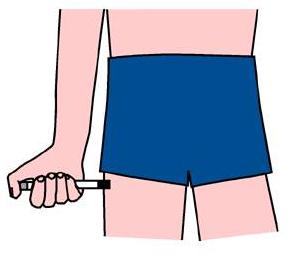
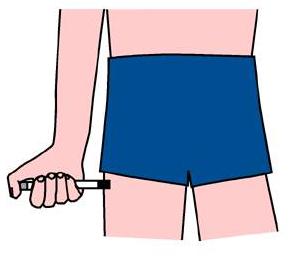
  • Help the casualty to administer their medication. Sufferers of severe allergies usually carry epinephrine (adrenaline) in an auto injector commonly known as an EpiPen (the brand name of the product).
    • Simply remove the auto-injector from its tube.
    • Remove the protective cap and strike the needle (narrow) end into the casualty's upper thigh at a right angle to the skin.
    • Hold the injector on the thigh for 10 seconds before removing and massaging the injection area for 10 seconds.
    • BE CAREFUL with the used needle and dispose of it safely by sealing it back in the EpiPen tube.
  • If the casualty is conscious sit them in the position that makes breathing easiest.
  • If the casualty becomes unconscious place them in the recovery position.
  • Carefully monitor the casualty's airway and breathing.
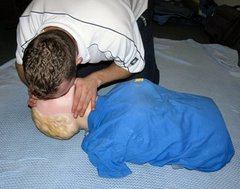
  • Be prepared to give CPR if the casualty stops breathing.
ANAPHYLAXIS NEEDS URGENT MEDICAL ATTENTION - SUMMON HELP IMMEDIATELY.
Sprains and Strains

The soft tissues around the bone can become damaged when exerted to sudden or unnatural movement. In general a strain refers to a damaged muscles, whereas a strain refers to damaged ligaments or tendons.

Recognition:
  • The affected area will be painful and tender.
  • The casualty will have difficulty moving the affected area.
  • There may be swelling and bruising.
Aims:
  • Reduce the casualty's pain and swelling.
  • Get medical aid if necessary.
Treatment:
When treating a sprain or strain remember the mnemonic RICE:
  • Rest: Get the casualty to sit or lie comfortably.
  • Ice: Apply an ice pack to the affected area. Avoid applying ice directly to the skin - wrap it in bag, piece of clothing or towel. This will serve to reduce the swelling.
  • Compress: Apply a support bandage and padding around the affected area. Check the circulation beyond the dressing every ten minutes.
  • Elevate: Raise the affected area using a chair, foot stool or similar. This reduces blood flow to the affected area, resulting in less swelling and bruising.
Recommend that the casualty consults their doctor if the symptoms persist for more then a few days. If the casualty is in serious pain or unable to move get them to a hospital.

Foreign Object in the Eye

The eye is very delicate and even the slightest spect on dust on the surface can cause the casualty great discomfort. Usually these objects can be 'blinked' or washed from the eye, but complications can arise if the object is sticking to the eye, penetrating the surface of the eyeball or resting on the iris (coloured part) or pupil. In these cases it is safest to seek proper medical attention.

Recognition:
There is often:
  • Pain and discomfort.
  • Redness and watering of the affected eye.
  • Blurred vision.
  • Eyelid of affected eye tightly shut or in spasm.
Treatment (object on white of eye):
  • Sit the casualty down in bright light and stand behind them.
  • Ask the casualty to tilt their head back and then carefully separate the eyelids with your forefinger and thumb.
  • Carefully examine each part of the eye by asking the casualty to look up, down, left and right.
  • If you can see a foreign object on the white of the eye try and rinse it out with a glass of water or sterile eye wash.
  • Lean the casualty's head towards the injured side and position a towel on their shoulder.
  • If you are unable to rinse the object away, dampen a swab (clean tissue, hankerchief etc.) and try to gently lift the object instead.
  • If lifting the object doesn't work either take the casualty to hospital.
  • If there is an object under the upper eyelid ask the casualty to pull the upper lid down over the lower lid. Hopefully this will brush the object away.
Treatment (iris, pupil or embedded object):
  • DO NOT touch any object sticking to the iris or pupil or embedded anywhere on the eye.
  • Place a sterile eyepad over the eye.
  • Take the casualty to hospital.

Fractures

A fracture is a break or crack in a bone. It usually requires considerable force to fracture a bone unless it is old and diseased, or young and supple. Fractures fall into two broad categories:
  • 'Open fractures' where the bone is protruding through the skin. An open fracture is usually accompanied by significant blood loss - the main priorities in this case are to control the bleeding, keep the injured area still and prevent infection of the open wound.
  • 'Closed fractures' where the damaged bone is contained within the skin. A closed fracture is contained within the skin and there is no external bleeding, although there is usually some internal bleeding caused by contusions (bruises) and tissue damage - the priority here is to keep the injured area still.
Recognition of fractures:
Us first aid trainers have a useful mnemonic to help us remember the signs and symptoms of a fracture: PLUSDICT:
  • Pain
  • Loss of power
  • Unnatural movement
  • Swelling or bruising
  • Deformity
  • Irregularity
  • Crepitus (grinding sound of the bones)
  • Tenderness
Treatment of an open fracture:
  • Put on gloves, if available. Ask the casualty to keep still.
  • Loosely cover the wound with a large, clean, non-fluffy pad or sterile dressing. Apply pressure to control the bleeding but DO NOT press on the protruding bone.
  • Place clean padding over and around the dressing.
  • Secure the dressing and padding with a bandage. Bandage firmly but not so tightly that it impairs circulation.
  • Immobilise the injured area by supporting it with your hands or padding around it with clothing etc.
  • Arrange for the casualty to get proper medical attention.
  • Treat the casualty for shock if necessary - DO NOT raise a fractured leg. Monitor the casualty's level of response, breathing and pulse. Check circulation beyond the bandage every 10 minutes.
  • DO NOT move the casualty until the injured area is supported unless they are in immediate danger. DO NOT press down on the protruding bone. DO NOT allow the casualty to eat, drink or smoke.
Treatment of a closed fracture:
  • Ask the casualty to keep still.
  • Immobilise the injured area by supporting it with your hands or padding around it with clothing etc.
  • Arrange for the casualty to get proper medical attention.
  • Treat the casualty for shock if necessary - DO NOT raise a fractured leg. Monitor the casualty's level of response, breathing and pulse.
  • DO NOT move the casualty until the injured area is supported unless they are in immediate danger. DO NOT allow the casualty to eat, drink or smoke.

Asthma


Calm and reassure the casualty, get them comfortable
and ask them to use their 'reliever' inhaler.


During an asthma attack the muscles of the air passages in the lungs go into spasm and the linings of the airways swell. This results in the airway becoming narrow and breathing becoming more difficult. Sometimes an asthma attack is triggered by an allergy, cold, cigarette smoke or some other external stimulus. Sometimes there is no recognised trigger for the attack - some asthma sufferers have sudden attacks at night. People with asthma usually deal with their own attacks using a 'reliever' inhaler, usually coloured blue, at the first sign of an attack. Asthma sufferers may also have a second 'preventer' inhaler, coloured brown, that reduces the risk of having an attack. The preventer inhaler will not help when an asthma attack in progress.

The main priorities are to calm and reassure the casualty, treat the asthma attack and maintain the casualty's airway.

Recognition:
  • Difficulty in breathing, with a very long breathing-out phase.
  • Wheezing when the casualty breathes out.
  • Difficulty speaking.
  • Signs of hypoxia (low blood oxygen) such as grey-blue lips, earlobes and nailbeds.
  • Distress and anxiety.
  • Coughing.
  • Eventually the casualty may become unconscious and stop breathing.
Treatment:
  • Calm and reassure the casualty.
  • Ask the casualty to take a puff of their reliever inhaler.
  • Ask the casualty to breathe slowly and deeply.
  • Let the casualty adopt the most comfortable position, usually sitting. Do not let the casualty lie down.
  • A mild asthma attack should ease within 3 minutes - if not, ask the casualty to take a second dose from their inhaler.
  • Ring for an ambulance if:
    • this is the casualty's first ever asthma attack.
    • the inhaler has no effect after 5 minutes.
    • the casualty is getting worse.
    • breathlessness makes talking difficult.
    • the casualty is becoming exhausted.
  • Be prepared to give resuscitation if the casualty stops breathing.

Nosebleeds

Nosebleeds are a very common problem in the home and work place. They are caused when the tiny blood vessels in the nostrils become ruptured. This normally occurs due to violent sneezing, nose picking or high blood pressure (hypertension). The main priorities are to stop the bleeding and maintain the casualty's airway.

Treatment:
  • Ask the casualty to sit down, tilt their head forward and pinch the soft part of their nose for 10 minutes. DO NOT allow the casualty to tilt their head backwards - this will cause them to swallow blood, possibly inducing vomiting and choking.
  • Reassure the casualty. Advise them to breathe slowly through their mouth. The casualty should avoid coughing, sniffing and swallowing during the nose pinch.
  • After 10 minutes ask the casualty to release their nose pinch. If bleeding persists they should re-pinch for up to 2 further periods of 10 minutes.
  • If bleeding has stopped cleanse the casualty's face with lukewarm water. Be sure to dispose of any used cleaning materials hygienically.
  • Advise the casualty to avoid exertion for a few hours after the bleeb. They should not blow their nose during this time.
IMPORTANT: If the bleed persists after the 3 x 10 minute nose pinches the casualty should seek medical attention.